Setting Boundaries as a Mom is a Mental Health Necessity
There's a specific kind of tired that most moms know all too well, where you've slept seven hours but still feel hollowed out by 10 a.m. Someone asks you a simple question, and you want to cry. You feel like you're just going through the motions of your own life. This is what happens when you've been running on everyone else's needs for so long that your nervous system has forgotten what it feels like to have room for your own.
“Setting boundaries” as a mom isn't just nice Instagram advice. It's one of the most practical things you can do to protect your mental health and show up the way you actually want to for your kids. But if boundaries feel uncomfortable or even unsafe to set at first, that doesn't mean you're doing something wrong - it actually makes a lot of psychological sense.
The Trap of the "Small Ask" and the Invisible Mental Load
Does any of this sound familiar…?
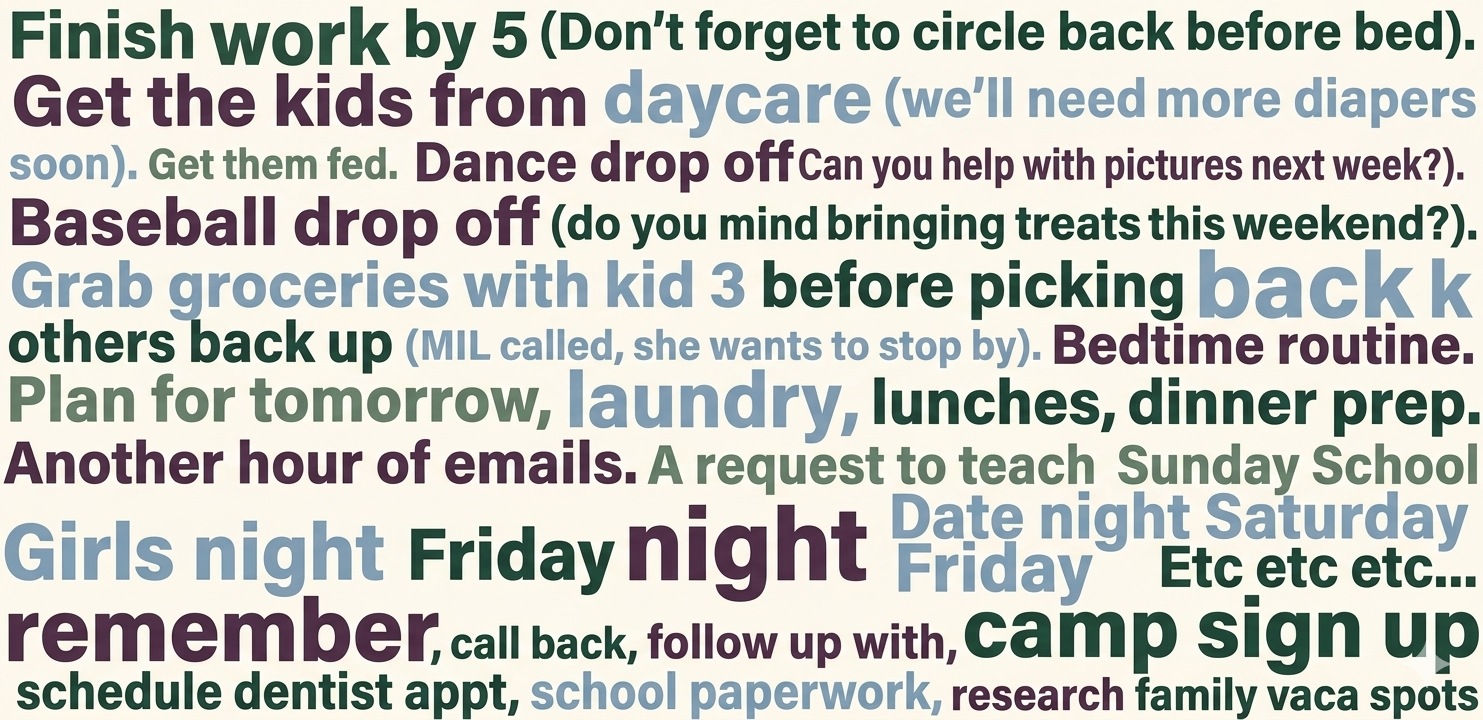
These requests always feel innocuous in the moment: it’s just thirty minutes…it’s just a batch of cookies…it’s just one email. Because each ask is small, saying no feels dramatic or even selfish. We’re conditioned to believe that "doing nothing" isn't a valid conflict, so we end up giving away the only thirty minutes we have to ourselves all week.
But when you trade away that sliver of time, you aren't just losing those thirty minutes - you’re losing the only window your nervous system had to reset. We’ve been taught that our rest must be earned, but the truth is that your unscheduled time is a mental health necessity, not a luxury you have to justify.
Why Setting Boundaries Feels So Hard for Moms (and It’s Not Because You’re Weak)
Most mothers don't struggle with boundaries because of a lack of willpower. They struggle because they have been historically rewarded for not having them. From a young age, we are taught that being "helpful" or "polite" means overextending ourselves to keep others comfortable. We’re conditioned to equate compliance with being a "good girl," chasing gold stars by doing all the things and rarely saying no.
By the time we reach parenthood, this is a deeply ingrained survival pattern. Your nervous system learned early: keep others happy, stay safe. So when you finally try to set a limit now, it feels "weird" or "selfish" because you’re unlearning a lifelong habit of self-neglect that was previously labeled as a virtue.
Setting boundaries is not about being difficult. It is about recognizing the "politeness tax" you have been paying with your mental health and choosing a more sustainable, enjoyable way to exist.
The Difference Between Healthy Boundaries and "Putting Up Walls"
Boundaries are not about putting up walls, shutting people out, saying "no" to everything, or rebelling because you’re fed up with something. Establishing boundaries is about getting off autopilot. It's about identifying what you can control and aligning it with your actual values and needs, not just what you think you "should" do based on everyone else's expectations.
A boundary is simply clarity - knowing what works for you, what doesn’t, and communicating that honestly. It's the difference between quietly resenting your mother-in-law's unsolicited advice and saying, "Thanks, but that doesn’t work for me.” It's the difference between staying up until midnight finishing someone else's project and saying, "I'm not able to take that on right now."
For moms especially, boundaries aren’t about becoming less caring - they’re about creating enough space to care for yourself, too.
Maternal Overload: The Real Cost of Neglecting Your Limits
When boundaries are unclear or missing altogether, the emotional and mental load of parenting keeps growing until something gives…and usually that something is you. “Maternal overload” (having too many responsibilities and not enough rest and support) is more than just a full calendar - it’s a leading source of chronic stress and a primary driver of burnout and anxiety (aka…duh!)
The signs are probably familiar to you: constant low-grade (or not-so-low-grade) irritability, resentment toward people you love (who may not even realize you're overwhelmed), or the feeling that you've lost yourself to managing everyone else’s needs.
And it’s not just about doing too much…it’s about never fully coming offline after doing all those things. Your nervous system stays in a low-level state of alert even when you're technically resting, because there's always another need, question, or thing waiting to be handled. Over time, that constant state of overstimulation takes a major toll on both your mental and physical health.
Breaking the Cycle: How Healthy Boundaries Benefit Your Children
When you start setting healthier boundaries, the shift is often gradual, but meaningful. Research shows that when parents experience less chronic stress and emotional overload (which boundary setting can help with), they tend to have greater patience, stronger emotional regulation, and more responsive relationships with their children. Certainly, boundaries won’t eliminate stress altogether, and you won’t become a zen-master overnight, but they can reduce the constant state of depletion that makes everything else about parenting feel even harder.
Healthy boundaries can also give you a clearer sense of yourself outside of your role as a parent. Research on caregiving identity shows that when one role becomes all-consuming, people are more likely to experience “role engulfment” and a gradual “loss of self.” Boundaries help you remain a whole person.
And in my work with moms, I’ve seen something else happen: when you set boundaries for yourself, your kids notice. Children learn emotionally mature habits by watching the adults around them. When they see you name your feelings, state your needs, and protect your time, they learn that boundaries aren’t selfish — they’re part of being a healthy person. Sure, they may not be thrilled if your "no" is directed at them in the moment, but they are learning a valuable life lesson (that they’ll hopefully appreciate later).
When Saying "No" Feels Unsafe: Anxiety and the Nervous System
For some moms, especially those navigating anxiety, perfectionism, or histories of trauma, boundaries don't just feel uncomfortable - they can trigger a response that feels almost physically painful or nauseating. This is because people-pleasing and anxiety create a feedback loop: saying yes keeps the discomfort at bay in the short term, which reinforces the pattern, which makes setting boundaries feel riskier over time. If you're also dealing with postpartum anxiety, this response can feel even more intense: racing thoughts, inability to relax, and intrusive "what if" scenarios spinning out of control.
This is your well-intentioned nervous system trying to protect you from a perceived social threat. What helps is working with it, instead of trying to override it:
Practice pausing before responding. You don't owe anyone an immediate answer.
Swap apologies for clear "I" statements. Say, "I need 10 minutes" or "I can’t do that today," and leave it at that. Remember that "No" is a complete sentence. You don’t have to provide an excuse or prove that your reason for saying no is "good enough."
Then let yourself sit with the discomfort of a small "no" long enough to see that nothing catastrophic happens.
Practical Boundary Examples for Partners, Parents, and Yourself
Setting boundaries doesn’t have to be a big dramatic declaration - most are just short, clear sentences. And yes, they might feel awkward at first - that's normal, because you're changing a pattern that's been running for years.
With your partner:
"I need you to take bedtime on Tuesdays and Thursdays, please."
"I’d like to talk about how we're dividing the mental load. Not tonight, but this week."
With your own parents (and extended family):
“I appreciate your concern, but we've made our decision on this.”
"I need you to call before coming over from now on.”
With your schedule:
Say "I'll check and get back to you" instead of an automatic yes. That pause itself is a boundary. It gives your brain time to catch up with your gut reaction to people-please.
"Thanks for thinking of me, but I’m not able to take that on right now".
With yourself:
The "good enough" rule applied to one recurring task (dishes, dinner, the state of the living room). Done is better than perfect, and perfection is costing you something important (likely your sleep and sanity).
No phone after 8 p.m. (not forever, just try it out tonight…and maybe tomorrow too)
Some people may push back when you start setting limits, especially if they’ve benefited from you not having any in the past. Remember, their discomfort is theirs to manage, not yours to fix.
Like any new skill, setting boundaries gets easier with practice. At first, they may feel awkward, and you might catch yourself apologizing or over-explaining. But over time, the mental and emotional space they create (more clarity, more energy, more autonomy) makes the practice well worth it.
How Maternal Mental Health Therapy Supports Boundary Setting
Working on boundaries in therapy isn't just about rehearsing scripts. It's about understanding why the limits feel so hard to hold in the first place (which is almost always rooted in something older than this season of motherhood) and doing the work (nervous system regulation paired with real-life action) until "no" stops feeling dangerous.
If you're carrying burnout, postpartum anxiety, relationship strain, or the weight of chronic people-pleasing, working with a member of the Ampersand Therapy Co. team can give you space to figure out what you need and how to get there.
Ampersand Therapy Co. offers secure online therapy for moms in Indiana, Iowa, South Carolina, Florida, and Idaho. You can book a free 15-minute discovery call here to see if we’re a good fit → https://ampersandtherapyco.clientsecure.me/